The 1960s Theory That Exposes the Blind Spot in Your AI Talent Strategy.
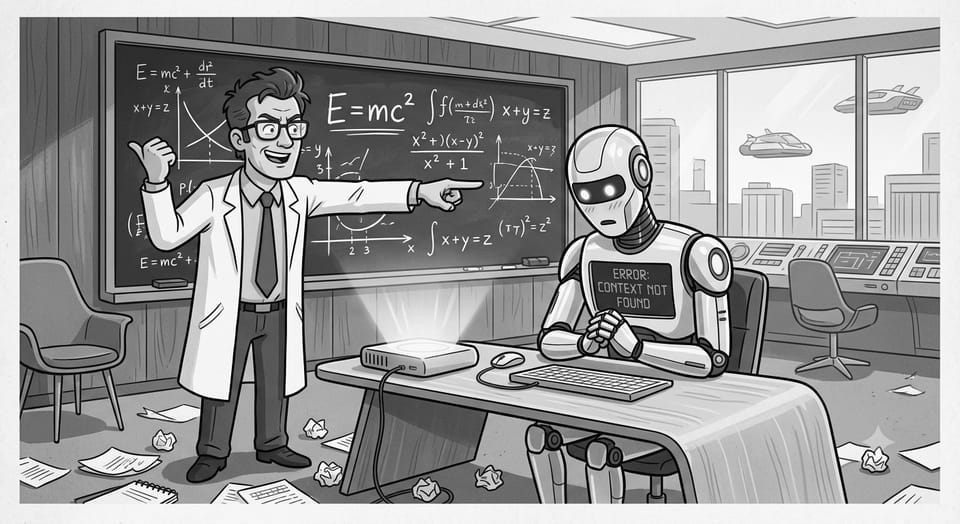
I recently came across Lou Adler’s Bayesian review of Amazon’s Connect Talent. The article itself is not primarily about Bayes’ theorem, but reading it sent me down an interesting path entirely. It reminded me about another framework called the Dempster-Shafer Theory of Evidence, and more specifically, what it reveals about the responsibility HR professionals carry as organizations lean harder into AI-driven decision-making. This is not a mathematics article. But bear with me for a moment, because the concept is worth understanding before we get to the practical point.
What Dempster-Shafer Actually Says (for those who are not familiar with the theory)
Dempster-Shafer Theory, developed in the 1960s and 1970s by Arthur Dempster and Glenn Shafer, is a framework for reasoning under uncertainty. Where traditional probability forces you to assign a precise likelihood to an outcome, Dempster-Shafer acknowledges something more honest: sometimes you do not have enough information to be precise, and that gap in knowledge is itself meaningful data.
The theory distinguishes between what you believe to be true, what you believe to be false, and what you simply do not yet know. It then allows you to combine evidence from multiple independent sources to arrive at a stronger, more defensible conclusion. Crucially, the framework treats incomplete information not as a problem to be papered over, but as a signal that more context is needed before a decision should be made.
That is the idea I want to bring into the business conversation about AI.
Where AI Falls Short on Its Own
AI systems are extraordinarily good at pattern recognition. They process structured data at a scale no human team can match, and they are consistent. Feed them a candidate profile, a performance record, a compensation benchmark, or a workforce dataset, and they will identify signals that human reviewers would likely miss.
But AI systems are only as complete as the data they are trained on. They draw conclusions from what they can see. What they cannot see, they cannot account for. And in human organizations, some of the most important context is invisible to a data model.
Consider a high-performer whose output metrics dropped over a six-month period. A model might flag this person as a flight risk, a performance concern, or both. What the model does not know is that this individual was managing a critically ill family member, received informal mentorship from a departing leader, and has since stabilized and re-engaged. The numbers told one story. The human context told another.
This is exactly the gap Dempster-Shafer was designed to address. The theory does not ask you to ignore incomplete data. It asks you to name the uncertainty, bring in additional evidence, and update your conclusions accordingly.
The HR Responsibility This Creates
In a previous article, I argued that HR professionals carry a responsibility to contribute human context to the way organizations use AI. Dempster-Shafer gives that argument a more precise foundation.
If AI is one source of evidence, and human observation and organizational knowledge are independent sources of evidence, then combining them produces better decisions than either source alone. This is not a soft claim about the value of empathy. It is a structural argument about how good reasoning under uncertainty actually works.
HR professionals sit at the intersection of data and people in a way no other function does. They know which teams are quietly disengaged. They know which managers have a pattern of losing talent that never shows up in exit surveys. They know when a compensation model is producing technically defensible offers that are culturally tone-deaf. They hold the evidence that the AI cannot see. The question is whether they are using it.
Bringing Context Into the Process
For this to work in practice, HR cannot remain downstream of AI-generated outputs. Reviewing a recommendation after the fact, or flagging a concern once a decision has already been made, is not contribution. It is cleanup.
Real contribution means being part of the process before conclusions are reached. It means asking what data the model was trained on and what it cannot account for. It means building the channels through which qualitative organizational knowledge flows into the same decision frameworks that quantitative data feeds. It means treating incomplete AI outputs the way Dempster-Shafer treats incomplete evidence: not as good enough, but as a prompt for more.
This is a shift in posture. It requires HR to move from validating what the system produces to actively shaping the inputs and the interpretive lens around them. That is a different kind of work than most HR functions are currently structured to do.
Why This Matters at the Business Levels
Organizations that use AI without a disciplined approach to human context are not making better decisions. They are making faster ones. Speed and quality are not the same thing, and in talent and workforce decisions, the cost of a wrong call compounds over time in ways that rarely show up in the immediate reporting cycle.
The business case is straightforward. Better evidence produces better decisions. HR holds evidence the AI cannot generate. If that evidence is not systematically included in the decision process, organizations are operating with a structural blind spot, and they are choosing to.
Dempster-Shafer Theory is ultimately about intellectual honesty. It says: here is what we know, here is what we believe, and here is what we still need before we should act with confidence. That is not a mathematical abstraction. That is exactly the standard business leaders should be holding their AI-assisted decision-making to, and it is exactly the standard HR professionals are positioned to help enforce.
The fires will always need fighting. But the deeper work is making sure the organization is not unknowingly building the conditions that start them.

Member discussion