Why Putting the Customer First Is the Only Business Move That Actually Matters
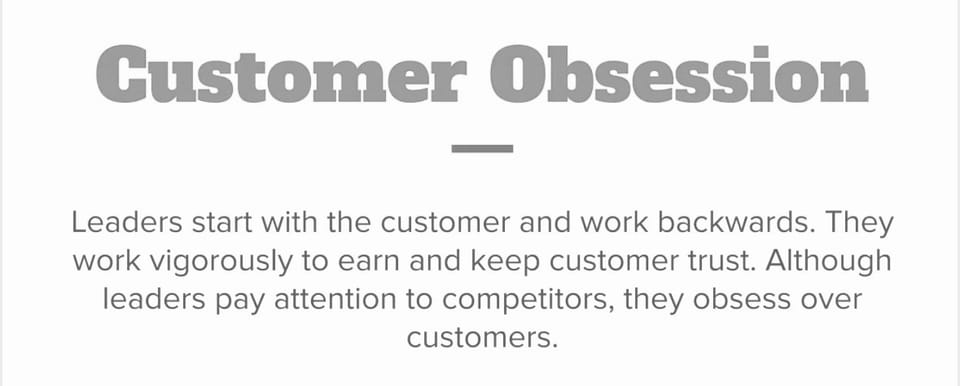
There is a quote that has been recycled, reinterpreted, and reshaped across decades of business thinking: the customer is always right. Like most ideas that get passed around long enough, its original meaning has been stretched and debated. But underneath all the noise, the core principle remains unchanged. The customer is the point. Everything else is a means to that end.
I want to be clear about where this piece is coming from. This is not a promotional exercise on behalf of my employer. What prompted this was a conversation with a long-time friend, someone I met at university, who has worked at several companies including Amazon, and who no longer works there. His perspective carried a particular weight precisely because of that distance. He was not looking back through rose-tinted glass. He was making a straightforward observation: in his experience across multiple organizations, no one executes customer obsession quite like Amazon. And when you hear that from someone with no stake in saying it, it lands differently.
The gap most businesses never close
Most companies say they are customer-focused. The language is everywhere. It shows up in mission statements, company values slides, and keynote addresses. But language is not a practice. The gap between saying the customer matters and actually organizing an entire business around that belief is wider than most leaders acknowledge. Where many businesses fall short is in how they calculate cost. When a decision arises that puts the customer first but carries a short-term financial hit, the reflex is often to pull back. The customer experience gets weighed against the quarterly number, and the quarterly number frequently wins. What gets lost in that calculation is the longer-term return on customer trust. Loyalty, advocacy, and retention are not soft metrics. They are compounding assets, and businesses that treat customer investment as an expense rather than a lever will keep making the same short-sighted trade.
The more strategic approach is to treat every customer-first decision as an investment with a return horizon that extends beyond the current cycle. That reframe changes everything about how leadership makes decisions.
Clarity is a competitive advantage
One of the underrated consequences of genuine customer obsession is organizational clarity. When the customer is the fixed point around which everything else is organized, there is very little ambiguity about what the company is trying to accomplish. Goals become easier to set. Priorities become easier to rank. Trade-offs become easier to navigate. Teams across different functions are all, fundamentally, working toward the same thing. That unified conviction is not a soft cultural benefit. It is a structural advantage. Companies that lack a clear center of gravity spend enormous energy on internal alignment, on debating what matters and why. Customer-obsessed organizations largely skip that tax. The answer to “why are we doing this?” is almost always the same: because it is better for the customer.
This kind of clarity scales. It holds up as organizations grow, as markets shift, and as competitive pressures intensify. A company that knows exactly who it is working for does not get lost.
Data is the bridge between intention and execution
Caring about the customer is not enough on its own. Intent without rigor produces well-meaning mediocrity. The organizations that sustain real customer obsession over time are the ones that use data to stay honest with themselves about whether they are actually delivering. That means tracking the right things. It means listening to what customers do, not just what they say. It means building feedback loops that are fast enough to generate learning and tight enough to drive action. And it means being willing to follow the data even when it is uncomfortable, especially when it is uncomfortable. The combination of genuine care and disciplined measurement is what separates companies that improve over time from those that plateau. One without the other is either sentimentality or surveillance. Together, they are how you build something that keeps getting better.
The proof is in the actual experience
The real test of any customer philosophy is not what the company says about itself. It is what happens when a customer interacts with it. The testament to customer obsession is not internal. It is apparent the moment you engage with the product, the service, the support, the follow-up. Consumers notice. They talk. And over time, their behavior tells the full story. Businesses that want to stay relevant do not need to copy anyone’s specific methods. But they do need to take seriously what customer obsession actually requires: sustained commitment, honest measurement, strategic patience, and the willingness to make the customer the answer to every question that matters.
The companies that do this well do not just survive market shifts. They define them.
Member discussion