We Need to Chill About AI “Taking Jobs”
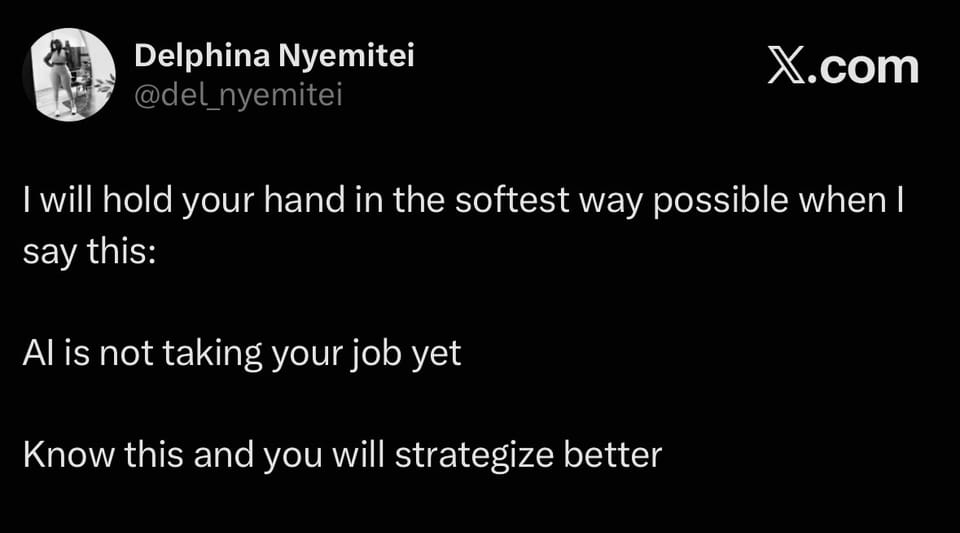
Spend a few minutes on X (Twitter) or LinkedIn and you will quickly find a familiar narrative: AI is taking everyone’s jobs. It shows up in viral threads, opinion articles, and anxious posts from professionals wondering if their careers are about to become obsolete.
The panic is understandable. Artificial intelligence has advanced quickly and tools from companies like OpenAI, Google, and Anthropic have changed how we write, code, design, and analyze information. But there is one important point that rarely appears in these conversations.
We are still in the learning phase of AI.
And that learning phase depends heavily on human expertise.
AI Cannot Mature Without Human Knowledge
Artificial intelligence does not emerge fully formed. It does not simply wake up one day capable of replacing complex professional roles. AI systems learn patterns from data, examples, corrections, and structured workflows created by people. The sophistication of an AI tool is largely determined by the quality of the human knowledge embedded into it. This is especially true in fields where nuance, context, and judgment matter.
Take talent management as an example.
On the surface, recruitment and people operations might look like processes that can be automated. Screening CVs, organizing interviews, tracking performance metrics. These elements can certainly be assisted by AI. But real talent management goes far beyond that.
Consider the following situations:
• A high performer whose productivity has dropped due to burnout
• A team restructuring that risks losing institutional knowledge
• Cultural differences affecting collaboration in a global team
• Compensation adjustments to retain critical talent without disrupting internal equity
These situations involve psychology, business strategy, organizational culture, and long term thinking. They are rarely solved with a one size fits all decision tree. AI can support these decisions. It can surface patterns and insights. But it still relies on human professionals to interpret context, manage relationships, and make judgment calls.
The Hidden Phase of AI Development
One of the most overlooked realities in the AI conversation is that companies are still actively collecting expertise to train and refine their systems. Behind every polished AI product is an enormous amount of human work. People design prompts, structure datasets, evaluate outputs, correct mistakes, and build frameworks that allow machines to understand real world problems. A small example illustrates this well.
A friend recently sent me a job posting from Anthropic for a Presentation Design Lead role. At first glance, this might seem surprising. Why would a leading AI company hire someone specifically for PowerPoint or slide decks? But the role made perfect sense when you read the details. The position focused on:
• Storylining complex ideas
• Consolidating information from multiple sources
• Creating clarity in presentations
• Structuring narratives for decision makers
In other words, the job was not simply about designing slides. It was about translating complex information into structured communication. When someone performs that role inside an AI company, they are doing more than producing presentations. They are creating patterns of thinking, frameworks for clarity, and examples of structured storytelling. All of that becomes valuable training material for future AI systems. What looks like a traditional role is actually contributing to the knowledge infrastructure that AI will learn from.
Businesses Are Investing in Learning, Not Replacement
The current strategy among many technology companies is not immediate workforce replacement. It is knowledge acquisition and capability building.
Organizations are trying to answer key questions such as:
• What tasks should AI assist with?
• Where does human judgment remain essential?
• How do we structure data so machines can learn effectively?
• What professional workflows can be partially automated without losing quality?
This phase requires professionals across multiple disciplines:
• Writers and editors
• Designers and storytellers
• Analysts and domain experts
• Product managers
• HR and organizational specialists
All of these roles help shape how AI understands the world. Ironically, the fear that AI will replace knowledge workers is happening at the exact moment when AI companies are hiring more knowledge workers to train their systems.
The Real Opportunity: Participate in the Training Era
Instead of viewing AI purely as a threat, professionals should recognize that we are living through a rare technological transition. This is the training era of artificial intelligence. And the people who contribute knowledge during this phase will shape how the technology evolves. There are several practical ways individuals can capitalize on this moment.
1. Become a Domain Expert
AI is strongest when it learns from high quality expertise. Professionals who deeply understand their industries become valuable because they can define the problems AI needs to solve. Whether in finance, healthcare, talent management, marketing, or logistics, domain expertise becomes training material for future systems.
2. Learn to Structure Knowledge
AI systems thrive on structured information. Skills such as:
• Breaking down complex ideas
• Creating frameworks
• Designing workflows
• Building taxonomies
are becoming increasingly valuable. The Presentation Design Lead role at Anthropic is a perfect example. Structuring information clearly is not just good communication. It also creates patterns that machines can learn from.
3. Work Alongside AI Tools
The most successful professionals today are not competing with AI. They are learning how to collaborate with it. Using AI for research, drafting, analysis, or brainstorming can dramatically increase productivity while keeping humans in control of strategy and judgment. This hybrid approach is already becoming the norm in many industries.
4. Focus on Human Strengths
There are certain capabilities that remain difficult for AI to replicate at scale:
• Empathy and relationship management
• Ethical judgment
• Strategic decision making under uncertainty
• Cultural awareness and negotiation
These skills will remain critical as AI becomes more integrated into business processes.
Perspective Matters
Technological change always triggers anxiety about the future of work.
History offers many examples.
The industrial revolution, the rise of personal computing, and the expansion of the internet all sparked fears of widespread job loss. What usually happens instead is a transformation of work. Roles evolve. New industries emerge. Old tasks disappear, but new ones appear in their place. Artificial intelligence will likely follow a similar trajectory. Yes, certain tasks will become automated. That is inevitable. But at this moment, AI is still learning from us. And until it fully understands how humans think, decide, negotiate, and solve complex problems, people remain an essential part of the system.
So perhaps the most rational response to the current AI panic is also the simplest. Take a breath. We are not at the end of human work. We are at the beginning of teaching machines how work actually happens.
Member discussion